2023年3月7日星期二

EN12966 M Series VMS

 ModelVMS-10M-RGB / VMS12M-RGB / VMS16M-RGB / VMS20M-RGB / VMS25M-RGB / VMS31.25M-RGB

Variable Message Sign is designed to be highly visible and readable, even in low-light conditions and heavy traffic conditions. ChainZONE uses large and bright LED displays with clear and concise text to ensure the information displayed is straightforward, providing important information to drivers and other road users through a flexible and effective communication method.


EN12966 Fixed Installation VMS Features
-Reliable SMD LED technology
-Modular design for convenient maintenance
-Integrated sensors for temperature and brightness detection
-ChainZONE’s patented ball-shaped lens technology
-The reflection of sunshine is greatly reduced, ensuring optical contrast ratio and delivering more clear images. Delicate color management technology, excellent display quality
-The embedded system can perform constant diagnosis and report error status to the central system in time
-The VMS can be monitored by the central management system which is developed independently by ChainZONE’s R&D team
-High luminance ratio of LED modules
-Unique rear design-fast and better heat dissipation in VMS


2023年2月22日星期三

EN12966 L Series VMS

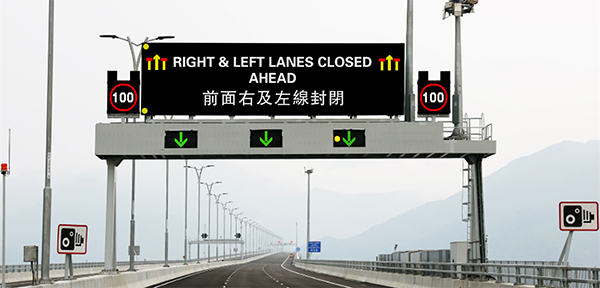
 Variable message signs (VMS) are electronic signs or displays that are used to convey real-time information to drivers and other road users. They are found along highways and other major roads, and are used to deliver information about traffic conditions, road closures, construction, weather warnings, and other important updates. The messages displayed on VMS are often altered remotely by traffic control centers, allowing for quick and accurate release of information.

Model: VMS 12L-RGB / VMS16L-RGB / VMS20L-RGB / VMS25L-RGB / VMS31.25L-RGB
LED VMS signs features:
-The embedded systems can perform constant diagnosis and report any abnormal status to the central system
-The VMS can be monitored by our proprietary central management system which is developed independently by Chainzone’s R&D team
-The excellent LED optical system meets EN12966 standards and provides the highest optical performance
-The LED light can be precisely projected to the spot where it is needed


-A wide range of pixel pitch options from 12mm to 31.25mm, adaptable to any application
-SMD LED technology, more reliable
-Modular design for easy maintenance
-Integrated light sensor for auto brightness control
-Integrated temperature sensor can trigger the fan if inner cabinet temperature gets high
-Simple to be programmed and more advanced functions for users’ options
Certification:
EN12966, ETL, CETL
Variable message signs application:
The variable message sign is a useful media to alert motorway users when there are abrupt changes in traffic patterns, road conditions, emergencies or special events. The application of VMS on the road can improve traffic flow while ensuring the safety of drivers and passengers. Variable message signs are ultra-bright and highly legible, with a variety of functions for many applications: lane closure, highway construction, work zone, parking lot guidance, and etc. A combination of different colour and sizes make these signs extremely efficient in conveying safety messages to the road users.

https://www.chainzone.com/


2023年2月8日星期三

Why is a Highways Traffic Guidance System Important?

 Highways are essential for transportation of people, goods and services. Efficient movement of traffic on highways is important for economic growth and quality of life. A highways traffic guidance system plays a critical role in ensuring smooth and safe movement of vehicles on highways. The system provides real-time information to drivers about road conditions, traffic flow and incidents, allowing them to make informed decisions about their journey.

 
Highways Traffic Guidance System
 

Below Are the Key Benefits of Having a Highways Traffic Guidance System:


Improved Safety

Accidents and incidents on highways can cause delays, congestion, and even fatalities. A highways traffic guidance system provides real-time information to drivers about road conditions and traffic flow, allowing them to make informed decisions about their route and drive more safely.
 

Reduced Congestion

The system provides real-time traffic information, which can be used to adjust signal timings, re-route vehicles, and manage incidents. This helps to reduce congestion and improve overall traffic flow.
 

Increased Efficiency

The highways traffic guidance system provides real-time information about traffic flow, allowing drivers to make informed decisions about their route and travel time. This results in more efficient use of road space and reduced fuel consumption.
 

Improved Incident Management

The system provides real-time information about incidents, allowing authorities to respond more quickly and effectively. This helps to reduce the duration and impact of incidents, resulting in improved traffic flow and reduced congestion.
 

Enhanced Traveler Information

The highways traffic guidance system provides real-time information to drivers about road conditions, traffic flow and incidents. This information is made available through various communication channels, including road signs, mobile apps, and websites.
 

Better Emergency Response

The system provides real-time information about incidents and road conditions, allowing emergency services to respond more quickly and effectively. This helps to reduce the impact of incidents and improve safety on the roads.
 

Better Data for Decision-making

The highways traffic guidance system collects data about traffic flow, incidents, and road conditions, which can be used for analysis and decision-making. This helps authorities to make informed decisions about road design, maintenance, and investment.
 

Enhanced Environment

The system helps to reduce congestion and improve traffic flow, which reduces fuel consumption and emissions. This has a positive impact on the environment and helps to promote sustainable transportation.
 

Improved Economic Growth

Efficient movement of traffic on highways is important for economic growth, as it enables the transportation of goods and services. The highways traffic guidance system helps to improve traffic flow, reduce congestion, and increase efficiency, which contributes to economic growth.

In conclusion, the highways traffic guidance system plays a critical role in ensuring smooth and safe movement of vehicles on highways. The system provides real-time information to drivers, improves incident management, and reduces congestion, contributing to a more efficient, safe and sustainable transportation network.

If you want to know more information about highways traffic guidance system, please contact us. We will provide professional answers.
contact us

2023年1月15日星期日

What Are Hydraulic Hose Rotary Joints?

Most hydraulics engineers are well aware that proper hose routing often means accommodating machine motion without overly stressing the hose, or letting it rub and abrade against other hoses or machine components. Otherwise, hose can prematurely fail, resulting in leaks, machine damage, downtime, costly environmental contamination and, potentially, a hazard to nearby personnel.


Hydraulic hose rotary joint

Hydraulic hose rotary joint


Swivel-type fittings are designed to allow the coupling and hose connection to rotate, which prevents twisting, kinking and excessive bending. That can extend hose life and reduce maintenance needs. It can also make for more efficient system plumbing. Using rotary joints can reduce the length of hose required between connections, eliminate the need for bent tubing to accommodate angled connections, and often can be connected directly to the hose line without adapters. Because swivel joints move, they can compensate for hose length changes when the system pressurizes and absorb hydraulic surges and shocks in a line.


Thus, many applications can benefit from the use of hydraulic hose rotary joints. These components permit an extensive range of articulation and movement in equipment operation and eliminate torque and twisting in hydraulic hoses. They can also simplify hose installation and maintenance.


Components

They consist of two major components, a stem and housing that can rotate relative to one another, as well as internal seals and bearings. Depending on the design, rotation can be unrestricted or somewhat less than 360°. Some rely on ball bearings to control movement, others have so-called ball-less designs with plain thrust bearings.


Types

Two basic types are in-line, where the opposing stem and housing fluid ports lie on a common axis; and 90° swivels, where the housing's fluid port is positioned to rotate on a plane 90° to the stem axis.


Hydraulic hose rotary joint

Hydraulic hose rotary joint


Applications

They are built to handle high pressures - often in excess of 5,000 psi - offer leak-free performance, resist hydraulic shock and side loads, and won't pull apart in operation. Over time the seals, back-up rings or bearings can eventually wear out, but many designs permit simple repair with seal replacement kits.


The swivel or hose should be mounted to the machine structure to ensure proper alignment and freedom of movement. While rotary joints are typically designed to allow free rotation with minimal friction, engineers should be aware that the weight of the attached hose, tubing or fittings - as well as the weight of the contained hydraulic fluid - may be substantial enough to place excessive side loads or bending moments on the swivel. The connection must be specified to handle such loads, or the seals may prematurely wear and leak. Side loading also causes excessive wear on the bearing surfaces and inhibits smooth swivel joint operation.


Hydraulic swivels are used in a wide range of rotary applications. Typical examples include grapples, forestry attachments, lift cranes and utility boom trucks, railroad maintenance equipment, demolition shears, and mobile excavators. And in this IoT era, special hydraulic rotary joints can be combined with electrical slip rings to transfer power or data signals. In addition to simple hydraulic swivels, a number of companies make rotary unions and rotating manifolds that transmit fluid from a single housing to multiple lines.


Design parameters

As with any other hydraulic component, engineers should consider a number of important design parameters. Swivel housings are available in steel and stainless steel, brass, aluminum and other common materials. Fluid compatibility with the specified materials is, of course, a must, and typical seal options include nitrile, ethylene propylene, neoprene and fluoroelastomer, to name a few.


Hydraulic hose rotary joint

Hydraulic hose rotary joint


Other considerations include pressure rating, internal flow characteristics and pressure losses, permissible rotational speed and torque requirements, SAE or ISO fluid ports options, and the ability to handle a range of ambient and fluid temperature ratings.

Many designs have an external exclusion seal to prevent ingression of contaminants, but it's always recommended to protect the swivel from dirt and abrasives whenever possible. For operation in harsh or corrosive conditions, a protective cover or elastomeric bellows are possible options.


And almost always, price is an important consideration. The cost of a rotary joint can be more than offset by cost-reduction benefits such as greater system design flexibility, improved system routing with less hose, simpler and quicker installation, fewer adapters and tube fittings, and longer service life.


We are a hydraulic hose rotary joint supplier. If you are interested in our products, please contact us now!

2022年11月18日星期五

How Does a Swivel Joint Work?

Swivel Joints come in various shapes and sizes based upon the application and the environment where it goes through. While style consideration needs to be provided to outside elements, all the swivel joints have 2 primary components: a shaft as well as real estate.

The idea behind a swivel allows the shaft to rotate while the real estate remains fixed-ready. The shaft has actually pierced holes of varying size and also depth beginning with its leading surface area. Variable opening midsts, as well as markings, define the circulation path of fluid within the swivel. Via inner design, the fluid is performed the shaft right into and also out of the swivel joint.


Swivel Joint


The real estate system includes machined flow as well as grooves to assist in liquid transfer within the swivel and also protect against cross leakages. Phoned number markings are found on the real estate outer diameter surface area and also the same can be discovered on the leading surface area of the shaft.

These numbers specify where an individual would anticipate the fluid to move in/out in between shafts as well as real estate via the machined inner passages. A collection of very carefully selected inner elements are fitted between the shaft as well as real estate at specified locations. These include seals, breaks rings, O rings, wearings, tiny bearings in specific applications.

The choice of interior parts is of vital importance while designing a swivel joint as severe interest needs to be given to the tolerances as well as the inner layout of the real estate grooves. Failing to comply with the advised layout and also machining requirements leads to leaking elements.

The flow of power, as well as signals, are sometimes required for particular applications and industries. Slide rings can be incorporated with the swivel joint via passing electrical cable televisions within the hollow inner size of the shaft.


Exactly how to Select a Swivel Joint?


In contrast to various other rotary parts in the exact same industries, a swivel joint mostly endures interior loads while functional. This is a direct outcome of pressurized fluid flowing within its interior components. To pick an appropriate swivel joint, multiple influencing factors should be thought about.

The most influencing element on a swivel joint is the inner securing option between the shaft and also housing. Really precise tolerances have to be preserved during the machining phase to create the required grooves for seals as well as inner elements to be fit.

Seals, o-rings, use rings, and bearings are inserted within these internal grooves and have to be able to endure the pressures caused by the fluid Swivel joints are rated by the manufacturer regarding their recommended operating pressures, temperatures, and speeds.

These values are directly associated with the interior elements requirements, geometric machining tolerances, and type of liquid used the substantial layout as well as area factors to consider the need to be given for a swivel joint and its ports.

Based on application needs, a swivel joint might have up to 9 different ports to provide fluid with various flows. A greater variety of paths result in substantial dimension as well as product boost.

Swivel joints can be customized in dimension as well as port dimensions with respect to application requirements. Space constraints, lots requirements, task cycle, as well as environmental surroundings are all variables that are taken into consideration while choosing an appropriate part


We are a swivel joints supplier, please contact us if you need them.

2022年11月9日星期三

The History of the Rotary Joint

Throughout the 19th and early part of the 20th century, the accepted method of supplying water or steam to a rotating cylinder was through the use of stuffing boxes or packing glands, which proved inefficient. The more these sealing materials wore, the more they leaked.


In August of 1933, R.O. Monroe and L.D. Goff, in conjunction with a local mill, designed and built the first rotary joint. It was a device that eliminated the problems associated with stuffing boxes and packing glands and allowed the water or steam to be introduced in a much more economical method. A spring-loaded mechanical seal was used to prevent the fluid or gas medium from dispersing. The secret to the rotary joint’s mechanical success was in the seal. It allowed parts of the rotary joint to rotate with the machine, while providing a leak proof seal for the fluid or gas flowing into the cylinder.


GHS/GHSA swivel joint


During the late 1930s and into the 1940s, rotary joints became the preferred method to admit fluid or gas into a rotating cylinder. Still, there were some problems associated with installation of the rotary joints. After World War II, several innovations were applied to rotary joint design. One of these was the use of flexible metal hose, which allowed the rotary joints some flexibility in movement as the seal wore. By 1946, several updates had been incorporated into the original design, and sizes were added to better accommodate the needs of the various industries requiring rotary joints.


By 1954, a complete redesign of the rotary joint was underway, mainly to reduce the physical size of the unit and to better accommodate the needs of specific applications. By 1957, many industries were also concerned about increasing the efficiency of heating and cooling within rotating cylinders. Kadant Johnson began a program of researching the effects of various types of syphoning devices (both rotary and stationary), and the effects of syphon clearances on the overall heat transfer from inside the rolls to the shell.


In 1959, a 60" x 250" (1.5 m x 6.35 m) paper dryer was converted for testing by Kadant Johnson, and actual testing of both rotary joints and various syphoning devices began in Pensacola, Florida, USA. In 1962, a research facility was set up in Three Rivers, Michigan, USA; and in 1963, the first pictures of the inside of an operating dryer were produced on 16 mm film.


People involved in designing and operating machines that required rotating cylinders learned a great deal about steam condensing rates and the actions within a dryer from these first films. Rotary joint technology and syphoning technology was shared with industry.


Rotary Joint


Through the late 1950s and into the early 1960s, this team of researchers continued to develop new designs and gather knowledge to address the needs of general industry. The need for higher operating temperatures and speeds required that the designs of rotary joints change again. Details such as quick disconnect nipples, pressure compensators, larger sizes, and longer service life were developed.


Into the late 1960s and early 1970s, various new seal materials, such as plastic, Teflon™, and ceramic were also tested.


While the early years were focused on sealing steam and water joints, today there are thousands of configurations of standard and custom rotary joints: self-supported or externally-supported; single- and dual-flow; applications using water, air, coolant, oil, molten salt, and gas; temperatures from very low to more than 1,000° F (538° C); and speeds from 1 to 50,000 RPM.


We are a GHP/GHPA rotary joint supplier. Please feel free to contact us if you need them!

2022年10月30日星期日

Hydraulic Valve Application And Maintenance

All the details of the design should be fully considered whether it can meet the needs of the device or equipment use. Before we design the hydraulic valve, we must first consider whether the hydraulic valve can meet the requirements of the entire hydraulic valve group, whether it can achieve each hydraulic machinery of each functional requirements, and finally to determine whether the design has been carried out in accordance with the principles of the entire hydraulic system. Although the hydraulic valve group is a combination of a certain number of hydraulic valves, it still has a lot of internal components, the number of these components can neither be particularly large nor reduced. If the number of these components is too much will increase the burden of the hydraulic valve group, that is, the design is not reasonable, once the number of components is small, the oil circuit integration will lose part of the role, not achieve the expected effect, and will waste materials.


1. The design principle of hydraulic valve


The design of the hydraulic valve is mainly for the design of the hydraulic valve group, and the hydraulic valve group must be considered before the design of the oil circuit, to determine in advance which parts of the oil circuit can be integrated, into the design of the oil circuit must pursue simple, to eliminate unnecessary steps. After determining the oil circuit, the main thing is the slant hole as well as the process hole, these things in the oil circuit should be reduced, so that as long as enough can be used, unnecessary too much, in the design of the slant hole and process hole should pay attention to the aperture and flow with the direction and location must be appropriate, to consider the overall situation, to ensure that the requirements are met. If there is some inappropriate direction or location, the need to adjust the components must ensure that it can be simple and convenient operation and maintenance.


Hydraulic valve


The design of the hydraulic valve is first discussed in terms of the design dimensions of the hydraulic valve. The length, width, and height of the hydraulic valve set are generally determined with reference to the size of the components that make up the hydraulic valve set, for example, the height of the hydraulic valve set, without affecting the actual role of the premise, as far as possible to keep in line with the height of the components. The length of the hydraulic valve group, without affecting the layout and structure, is determined by the hole diameter of the screw hole or the size of the length.


The width of the hydraulic manifold is determined by roughly the same factors as the length. Next, we introduce labeling dimensions, this step is mainly applied in the design of the drawing, to label the ports of some components, apertures, the size of each group, size, etc. Finally, the design of the channel, the most important thing in this design is the layout, a comprehensive overall arrangement of the system, the classification of the oil circuit, first of all, must make the main oil circuit, and then, for the small oil circuit or other oil circuit and then gradually guide. These hydraulic valve channels, in the design of the time, must ensure that the length is appropriate, the corner is relatively small, and the hole of the oil channel is appropriate, so as to effectively control the weight, size, and volume of the hydraulic valve group, in order to make reasonable use of.


2. The application of hydraulic valve set


In the present situation, according to different situations and different uses of hydraulic valves, hydraulic valves can be divided into many types, this article focuses on one of them, this hydraulic valve set includes four parts, it is composed of the cartridge, control cover, pilot control valve and integrated block of two-way cartridge valve.


The following describes the main contents and functional uses of these four parts. The structure of the cartridge can be considered as a slide valve or cone valve, the role of this part of the component is very important to control the flow direction, flow rate, and pressure of the oil in the channel or elsewhere. The control cover can effectively control the cartridge valve real-time work, mainly because it is composed of a number of pilot control components, these components can regulate or control the work of the cartridge valve, this control cover is basically even a bridge, connecting the control valve and components, and, the pilot control valve should also be selected to install on it.


Hydraulic valve


Two-way cartridge valve in the current situation in our country is more common, from the economic point of view, because its components and the necessary piping connection are relatively small, it is easy to integrate, so it is very convenient and suitable for large-scale go mass production, which can largely reduce production costs. From the point of view of use, its structure determines that it will be small in size so it is very convenient, and its high speed of control and switching determines that it is very efficient and reliable in use. In addition, it can be controlled with high power, which has the advantage that the loss of pressure will be reduced and the loss of heat will also be reduced. Finally, the two-way cartridge valve is not affected by commutation. The main role of the two-way cartridge valve is to connect the route of the fluid or control it to disconnect.


3. Maintenance of hydraulic valve


With the growth over time, the hydraulic valve will inevitably have some failure, which involves the maintenance of the hydraulic valve. In actual production, the maintenance of the hydraulic valve is mainly timely cleaning, some parts of the combination of optional, as well as the size of the repair. Hydraulic valve channels have oil, it is easy to occur the precipitation of oil, the precipitation will make the hydraulic valve some unnecessary failure, so we must promptly clean up, the hydraulic valve disassembly and then cleaning, so as to timely make the function of the hydraulic valve to restore.


Cleaning time to pay attention to safety, a lot of precipitation is not easy to clean and needs some cleaning fluid, these cleaning fluids are generally corrosive or toxic, and even some are flammable, so must be careful and cautious. After cleaning the finished parts must be well stored, so that it does not appear to be corroded again. After the cleaning is completed and then installed, the hydraulic valve can continue to operate after testing. If some parts of the hydraulic valve are broken and serious, in this case generally choose to reassemble the optional. Hydraulic valves if there is special experienced personnel maintenance, will greatly increase their life, and their reliability and performance will be maintained at the original level, even so, we should be vigilant in the daily production, to prevent accidents.


Changsong Industrial Equipment Shandong Ltd. offer various valves and system solutions required in hydraulic systems. If you are interested in our products, please contact us now!

Tips for Buying Indoor LED Screens

  What Are LED Screens? LED (Light Emitting Diode) screens use tiny LEDs to create images. Unlike traditional screens, they offer vibrant co...